
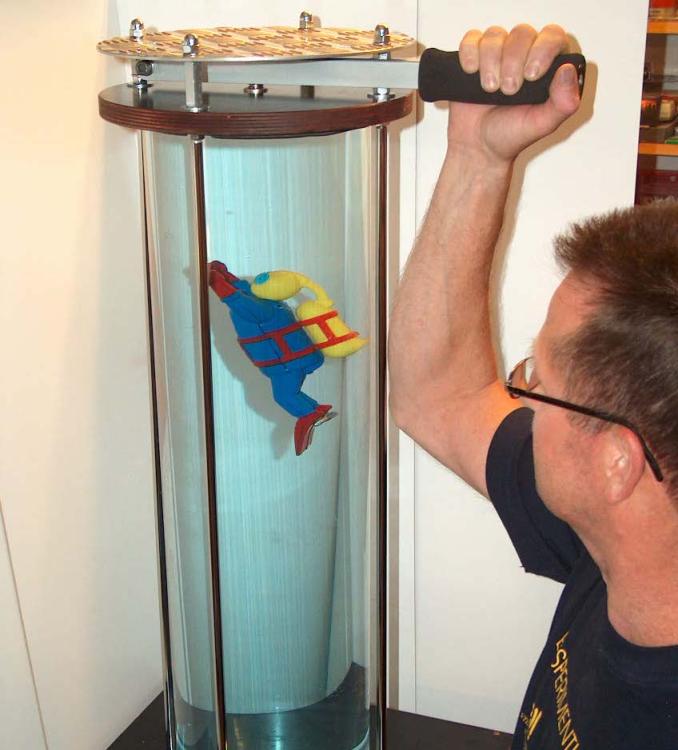
Pull the handle. What happens to the scuba diver?
Any object, wholly or partially immersed in a fluid, is buoyed up by a force equal to the weight of the fluid displaced by the object.
— Archimedes of Syracuse
The cartesian diver experiment is set up by placing a "diver"—a small, rigid tube, open at one end, in a larger container with some flexible component. The larger container is completely filled with water, and must be made airtight when closed. The "diver" is partially filled with a small amount of water, just enough to allow it to contain enough air so that it is nearly neutrally buoyant, but still buoyant enough that it floats at the top while being almost completely submerged.
The "diving" occurs when the flexible part of the larger container is pressed inwards, increasing the pressure in the larger container, causing the "diver" to sink to the bottom until the pressure is released, when it rises back to the surface.